
How we perceive reality around us heavily depends on the narratives that dominate our public spaces.
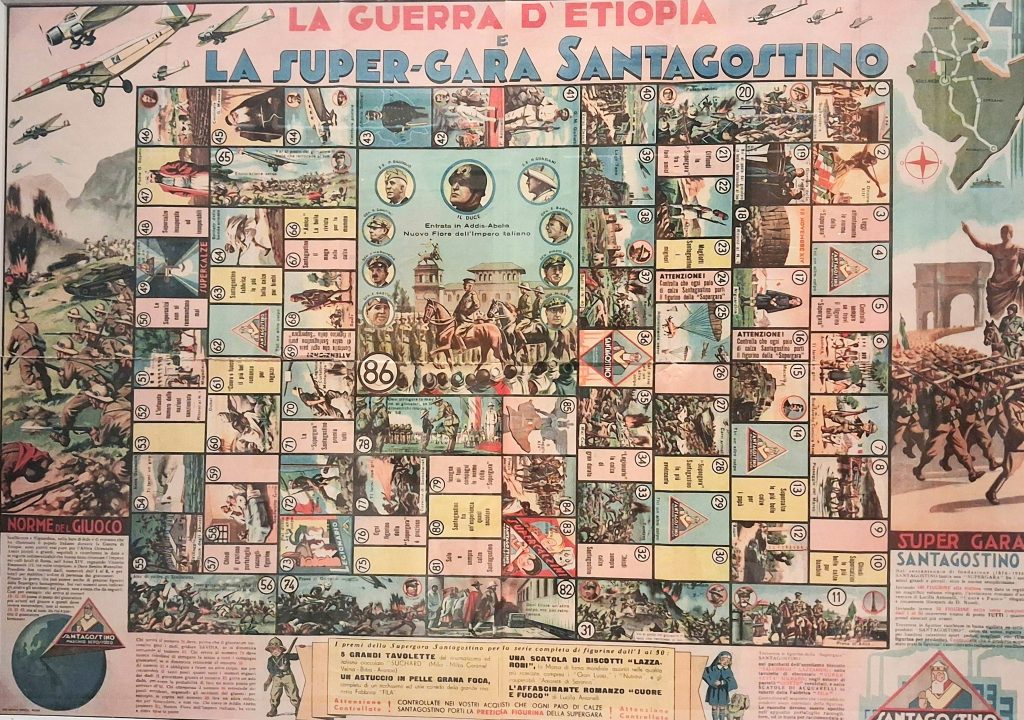
An example: During the Second Italo-Ethiopian War/Invasion (1935-36), the Italian government launched an intense propaganda campaign. All means were employed to reach the collective consciousness seeking to foster the ‘Italian Empire’ and resurrect the glory of ancient Rome in the popular imagination. The narrative claimed that Africa’s future required Italy’s ‘salvation’. Books and school curricula were not spared. In 1936, a Milanese company created a boardgame that was heavily advertised and played by children. The two young protagonists followed historical events and the entry of the Italian army to Addis Ababa where they would meet an Italian boy and girl, two fascist models to be imitated.
Collective narratives always dominate the public space shaping our perception of reality. Most people surrender to collectively formed worldviews and ideologies that eliminate uncertainty and provide them with an identity and an illusional protection. Most people tend to accept or at least embrace the social systems they are born into because they consider them natural. The more people devote themselves to groups and their intense demands to conform, the more they lose their individual features.
Do we really want to surrender to power structures, systems and realities just because they feel natural or safe? Can we bypass our right and responsibility to understand and choose? Don’t we owe it to ourselves to actively question and explore what visions of the past we carry in our futures, and what visions of the future we live by in the present?
(image from MUDEC Milan)