
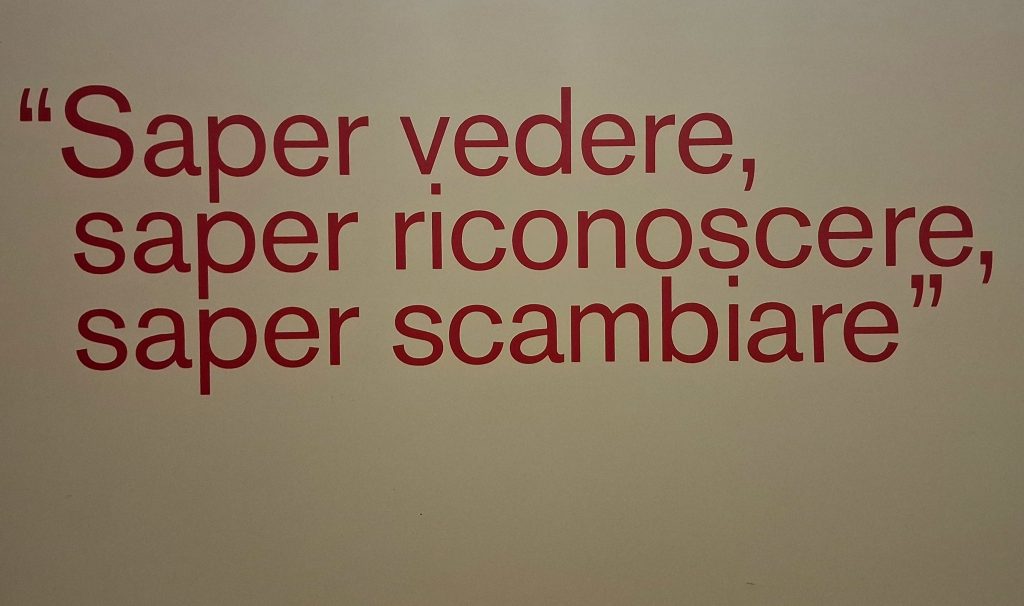
Upon entering the Triennale’s shop in Milan, Gae Aulenti’s phrase caught my eye: “Saper Vedere, saper Riconoscere, saper Scambiare” (Knowing how to see, knowing how to recognise, knowing how to exchange). Aulenti was a prominent architect in postwar Italy. For her, space was a continuous, dynamic narrative, woven into history, context, and human relations. Active observation over passive seeing, being aware of associations and context, and orchestrating a dialogue among the past, present, and future were for her the cornerstones of good design.
If good design requires such components, what about the design of our lives? Do we train our eyes to observe the world critically, beyond our preconceptions? Do we cultivate the skills to read what lies unseen beneath and beyond the surface? Do we recognise the historical weight of the narratives that occupy our public spaces, i.e. the values and memories, the worldviews they carry? Do we ask questions such as “what does my way of seeing tell me about how I make sense of the world?” or “why does this image make me see the world in this particular way?” or “what assumptions make me see it that way? Could I see it differently?”
Are we willing to explore our visuality, to re-interpret, re-frame, and re-associate, creating new spaces for dialogue, understanding, respect and mutual growth? Our visuality is the regulator of our reality.