
Heritage is enacted and depicted. Both are powerful means for collective memory to be preserved. The “Santa” Festival is one of the largest and most important in Corsica. Each year, the three-days event culminates on September 8th, and hundreds gather to celebrate the Nativity of the Virgin Mary at the village of Casamaccioli.
The enacted part involves the religious service in the church yard and the “granitula”, the spiral procession of the wooden statue of the Virgin Mary in the village square. Traditional chants accompany the service and the procession, and vivid musical improvisations are central during the previous days.
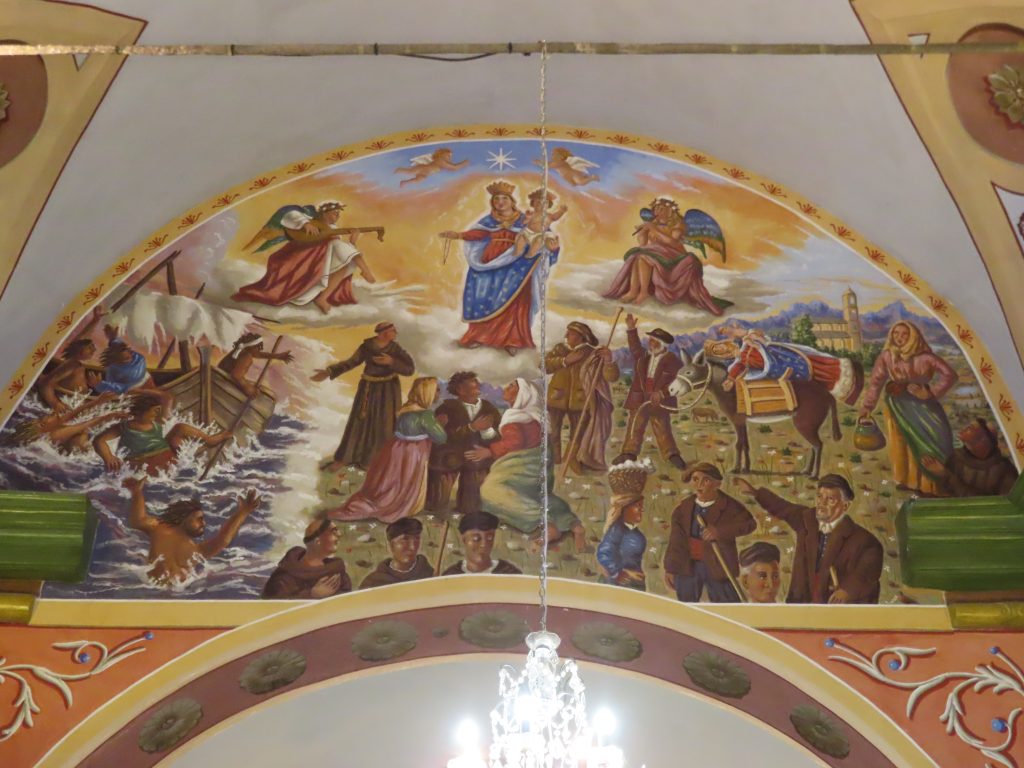
The depicted part appears in two ways: as a fresco in the church, on the wall above the sanctuary, and as a mural, on a house wall, just across from the church.
The fresco narrates the story of the Santa: the vow made to the Virgin Mary by a captain back in the 15th c., when his ship was saved from a storm; how he offered Her a most beautiful statue at the nearby Franciscan Monastery; how, a century later, the statue was saved from the monastery’s destruction by the Turks and carried by a mule into the mountains of the Niolu; and the miraculous choice of the exact spot where a new church was built.
The fresco immediately catches the attention of anyone entering the church not only because of its prominent positioning, but because of the aesthetic language chosen: a very comprehensible arrangement of visuals in almost folklore aesthetics that involve all parts of the story: the stormy sea, the tortured ship, the Franciscan monk, the peasants, the mule with the statue and the village landscape.
Outside the church, the black and, rather, abstract figures of the mural are a reminder of the spiral procession that symbolizes the circle of life, death and rebirth, as well as community bonding. The coiling movement represents turning away from the outer world to focus completely on internal prayer and contemplation, while the uncoiling signifies the passage from earthly existence to eternity, as well as death and spiritual renewal. The coiling and uncoiling motion mimics ancient labyrinth rituals rooted in ancient Mediterranean symbolism and adapted into Christian tradition. How fascinating it is to witness the similarities in human needs and fears throughout the centuries, and the adaptability of traditions created to reassure, make tangible, and explain.